
 Terviseportaal
Checklist for patients coming for inpatient or day surgery at the Women's Clinic
The purpose of this leaflet is to provide patients with the necessary information when they come for inpatient or outpatient surgery.
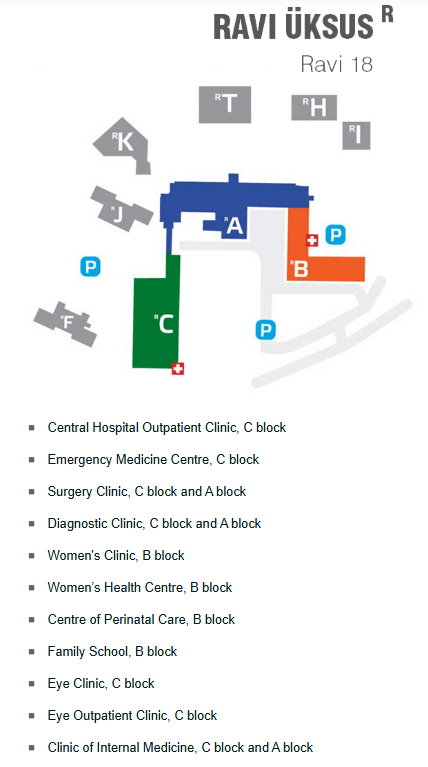
We kindly ask you to arrive at the reception of the Women's Clinic at the time specified on your referral letter. The reception is located on the first floor of Building B, Ravi tn 18. At the reception, you will be admitted to the hospital and shown to the ward.
If you are unable to come to the hospital at the scheduled time (e.g. due to illness), please let us know at the earliest opportunity by calling:
-
+372 620 7171 (weekdays 8:00-16:00)
-
+372 620 7168 (outside of working hours).
Regular medications
Before the surgery, inform your doctor or nurse about all the medications you are taking, such as diabetes medications, blood thinners (warfarin and other oral anticoagulants, aspirin, clopidogrel) and/or painkillers. Your treatment plan may be adjusted if necessary. Also inform your doctor or nurse of any medications you have taken in the last month (e.g. antibiotics). You should take regularly used medications on the morning of the surgery with a small amount of water to help swallow the pills.
Unless instructed otherwise by your doctor, do not take any diabetes medications or have a morning insulin injection on the morning of your surgery.
Come to the hospital with:
-
A valid identification document (passport, ID card, driver's license, etc.)
-
A completed and signed "Pre-anaesthesia questionnaire" and/or "Informed consent for the procedure" (if they have been provided to you)
-
Your regular medications
-
Personal hygiene products, including sanitary pads
-
A change of shoes (preferably comfortable non-slip shoes with closed heel)
-
Any necessary aids (crutches, cane, glasses, hearing aids, etc.)
-
Headphones, smartphone/device chargers, power bank (if needed)
-
Personal clothing (if desired)
We recommend that you do not bring large sums of money or valuables to the hospital. You can leave your documents, money and valuables for safekeeping at the department if you wish. The hospital is not responsible for items not deposited for safekeeping.
Before coming to the hospital
Before coming to the hospital, we ask you to have your teeth and mouth checked and treated if necessary by a dentist. If the teeth are not treated, anaesthesia can cause a tooth to break or become loose. Untreated oral infections can also lead to infections and postoperative complications.
Please ensure your personal hygiene before coming to the hospital: wash your hair and body and trim your nails. To prevent skin injuries and infections, we recommend not shaving the surgical area at home. We recommend that you remove nail polish from your fingernails before coming to the hospital.
As the body’s normal protective functions do not work during unconsciousness (incl. under general anaesthesia), there is a risk that the stomach’s contents may enter the airways and cause life-threatening complications. It is therefore important to stop eating and drinking opaque liquids (e.g. milk, coffee or tea with milk, fruit juice with pulp) six hours before anaesthesia. You must stop drinking clear liquids (transparent liquids without solid particles, e.g. water, tea or black coffee, fruit juice without pulp, most sugary soft drinks) two hours before anaesthesia. We ask that you do not chew gum or smoke for two hours before anaesthesia.
Identification
When you arrive for inpatient or outpatient surgery, we will ask for your first and last name, date of birth and identity document, and compare the information you provide with the data on your identity document.
You will be fitted with a wristband at reception. Before any procedure, medication administration or surgery, we will re-identify you by asking for your first and last name and date of birth and check that the information matches that on your wristband. This helps prevent mistakes and ensures your safety.
After the surgery
After an outpatient surgery, you will be offered yoghurt and tea. After an inpatient surgery, you will be provided with food according to the diet prescribed by your doctor.
During the first two weeks after surgery, you may only take showers; avoid baths, saunas and swimming. Use the pain medication recommended to you (either prescription or over-the-counter medications).
Please think beforehand about who will help you get home safely after the surgery. It would be helpful if someone could pick you up and accompany or transport you home. After surgery under local or general anaesthesia, refrain from driving a motor vehicle or operating dangerous or attention-demanding equipment for 24 hours, as the medications used for anaesthesia can slow down reaction time.
On the day of discharge, a staff member from the department will prepare a bill for your bed days, which can be paid at any hospital reception desk or via the iPatsient patient portal. Please inform your doctor if you need a certificate of incapacity for work.
Please vacate your bed by 12:00 on the day of your discharge from the hospital.
Smoking in the hospital
Our hospital is guided by the smoke-free hospital policy, therefore smoking is not allowed on hospital premises and grounds; the use of cigarettes (including e-cigarettes), cigars, cigarillos, smoking tobacco or herbal smoking products is prohibited. Smoking is only allowed in designated pavilions on hospital premises.
We appreciate your cooperation and wish you a speedy recovery!
Location plan of the buildings of the Ravi tn unit of East Tallinn Central Hospital
ITK1156
Approved by the decision of the Medical and Nursing Care Quality Commission of Aktsiaselts Ida-Tallinna Keskhaigla on 04.02.2026 (Protocol No. 2.2-8/3-26)